Field Notes · Essay No. 001
The First Noticing
How a nature practice actually begins. It rarely starts in the woods.
I am a nature enthusiast before I am anything else. A forager. The kind of person who notices when the spring edibles are about to pop and plans a whole weekend around them, with dinners in mind.
So when my daughter was born, the question was never whether I would bring her outside. It was how soon I could do it safely. When and how could I strap her to my chest and get into the woods to meet the first signs of life.
She was still small when I first brought her along just to get us both some air. Strapped in. Slower than I used to move. Stopping more. Pointing at things I would have walked right past. Somewhere in that slower rhythm, the whole practice changed. It was not my foraging trip anymore. It was ours.
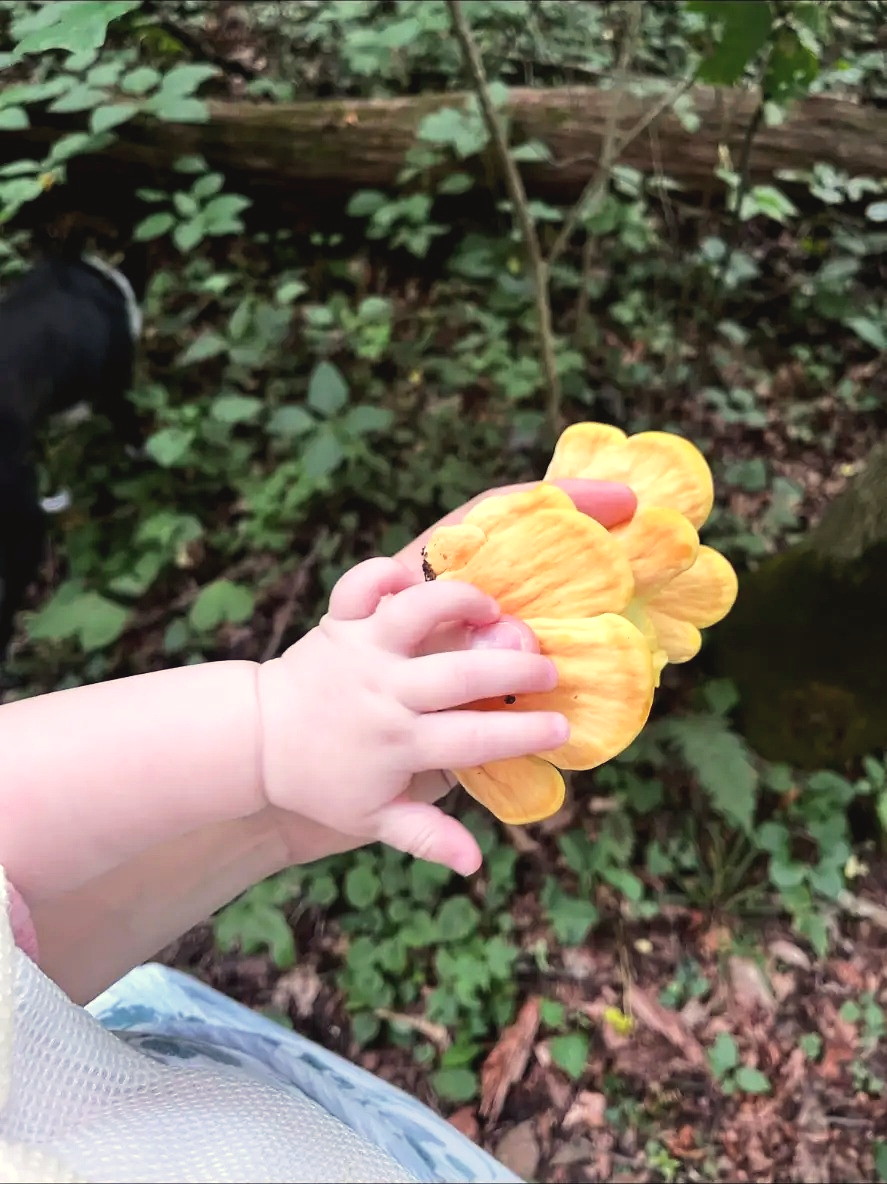
The first thing she ever found was young bright orange chicken of the woods mushrooms. Ten months old. Too young to know what she was looking at, but old enough to know it mattered.
I have a photo of our hands holding it together. Hers are tiny. The mushroom is almost too bright to be real. That image lives in my head.
That was the moment I understood. Nature walks with Mommy were becoming something much bigger than a walk.
She is almost four now. She can identify plants and mushrooms on a small scale. She knows which mushrooms are in the bolete family. She spots a bug on the trail and wants to find out the scientific name in a field guide. She crouches for roly polys with the same seriousness I bring to a good flush of chanterelles (which she usually spots first). The noticing is hers now. I let her take the lead.
I did not teach her to forage. I taught her to look. The foraging came from the looking.
That is where this project came from. Not a business plan. Not a brand strategy. Just years of bringing her with me. Of connecting with wild spaces with a wild eager child next to me.
Years of realizing the smallest version of this practice — one parent, one child, one ordinary patch of green — was worth protecting. That it was SO worth sharing.
I want other parents to notice. Not to become experts. Just to become the adult who slows down when a child stops walking.
Most of the time we (the big people) forget what the wonder of a child looks like. We rush them along without the pause.
There is no version of this practice that is too small. I have come to learn that our littles are some of the most important teachers we always have available to us. To fill our hearts and minds with the curiosity that so many of us have lost along the way.
Our job is mostly to protect the pause.
One moment. One pause. One small spark of wonder.