Guide
Leaf identification, four questions at a time.
A child can identify most trees on a street without a book. It takes four questions, asked in order, and a leaf held still long enough to answer them.
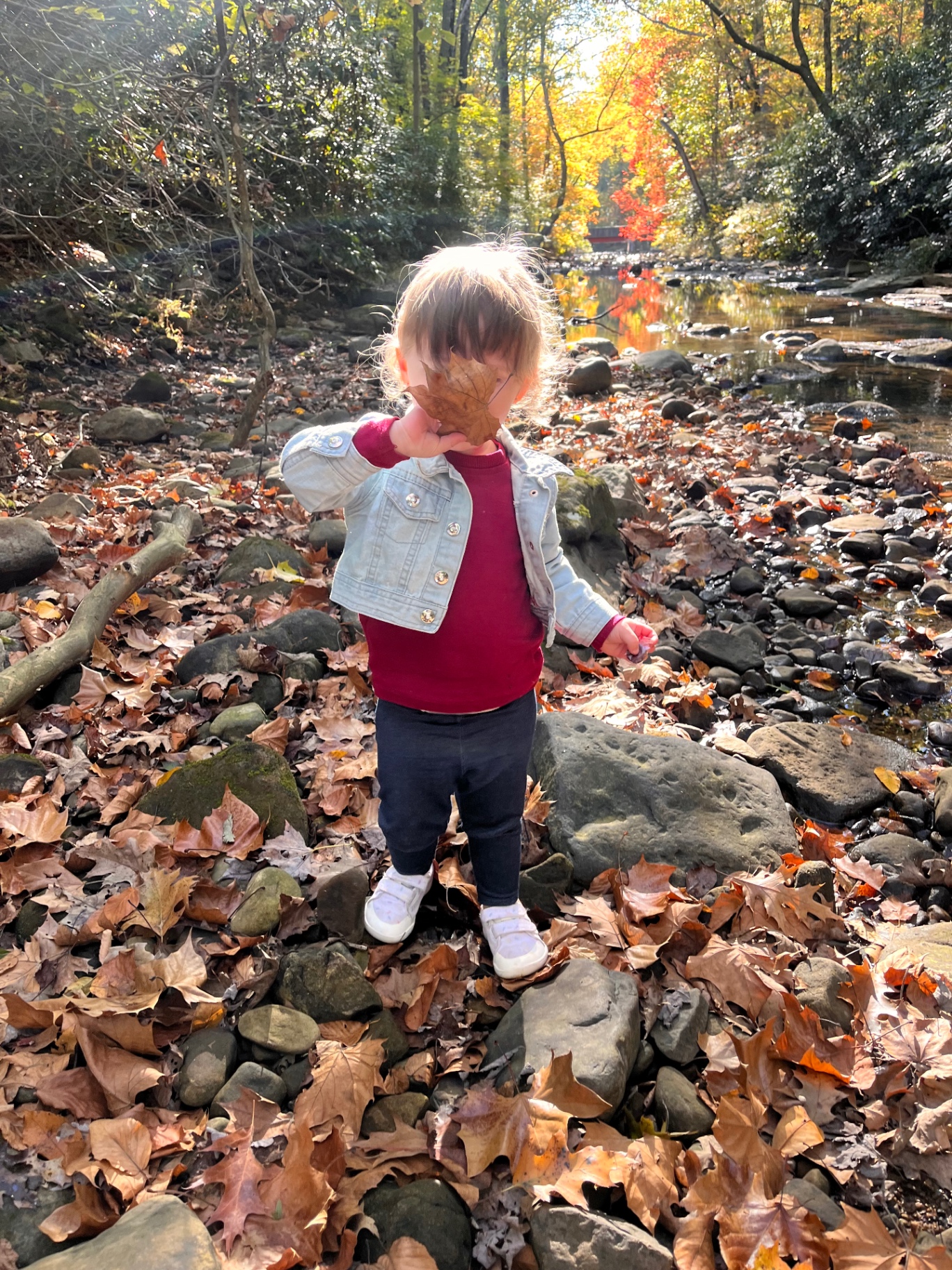
Start with the leaf in hand
Pick one leaf, ideally a full-grown one from the middle of a branch. Leaves near the tip of a young shoot are often the odd ones, and they will send you the wrong way.
Answer the questions out loud. The naming matters less than the looking, and a child who can describe a leaf can find it again in any guide.
The four questions
Question 1
Is it one blade or several?
A simple leaf is a single blade. A compound leaf is several leaflets on one stalk. Find where the bud sits on the twig: everything past that bud is one leaf, however many leaflets it holds.
Question 2
What does the edge do?
Smooth, toothed, or lobed. Oak leaves have rounded or pointed lobes. Cherry and birch have fine teeth you can feel with a thumbnail. Magnolia is smooth all the way around.
Question 3
How are leaves arranged on the twig?
Opposite leaves sit in pairs. Alternate leaves stagger. In the Mid-Atlantic, opposite arrangement narrows things down fast: maple, ash, dogwood.
Question 4
Where do the veins go?
Veins that fan out from one point mean maple or sycamore. Veins that run off a single center rib mean oak, beech, cherry. This is the question children answer best, because it is visible in a rubbing.
Eight trees children bring home
These are the leaves that end up in our pockets most often in the Mid-Atlantic.
Red maple
Three main lobes, opposite pairs, red stems in spring.
Sugar maple
Five lobes with smooth curves between them, no teeth in the notches.
White oak
Rounded lobes, pale underside, leaves often stay on young trees in winter.
Red oak
Pointed lobes ending in a bristle tip.
American sycamore
Very large, broad, and shallow-lobed, with mottled bark above.
Tulip poplar
A leaf that looks cut off flat at the tip, like a cat's face.
Black cherry
Narrow, finely toothed, with a smell like almond when crushed.
Sassafras
Three leaf shapes on the same tree: mitten, three-lobed, and plain oval.
Keeping what you find
A rubbing records the vein pattern better than a photograph. Press the leaf under a stack of books for a week if you want to keep it flat, or use a wooden flower press if leaves keep piling up on the windowsill. Our field guides cover backyard birds and roadside wildflowers with the same approach.